
On this page:
- Why Choose Art?
- Careers
- Real-World Experience
- Success Stories
- Academics and Curriculum
- Concentrations
- Admission
- Scholarships
Why Choose Art?
You can combine a liberal arts education with your art studies and a concentration in studio art in Wright State’s Bachelor of Arts (B.A.) degree program. You can pursue a concentration in painting, photography, printmaking, or sculpture during a more intense and professional program in Wright State’s Bachelor of Fine Arts (B.F.A.) programs.
You will be largely responsible for determining the options that best meet your individual needs and interests because self-expression and self-learning are the ultimate goals of the B.F.A. program.
B.F.A. degrees can be combined with an art education component or allow you to supplement your Fine Arts education with a Graphic Arts certificate from Wright State's Lake Campus. The Graphic Arts Certificate is designed for the art student interested in supplementing the curriculum with graphics-based technology courses. It will increase their knowledge and career potential in a variety of art-related fields. Students will gain hands-on experience through a variety of digital graphics-based software programs. Students may also pursue certificates in graphic design or interior design from Sinclair Community College.
Many graduates of these programs are successful applicants to graduate programs in fine and applied arts and education.
Begin your studies with introductory courses in drawing, 2D and 3D foundations, photography and art history. These courses are designed for the beginning artist and guide your development in the visual arts. You will expand and express your knowledge and grow in self-expression by exploring the processes and language basic to all visual arts. Instead of following a system of independent courses in a given medium or discipline, you will investigate issues and ideas in a variety of visual modes.
Careers
Earn your degree from Wright State’s School of Fine and Performing Arts go on to an exciting career in education, commercial art and photography, museum and gallery administration, or fine arts. Successful graduates of our programs have found rewarding careers in many non-art related fields as well. Recent graduates have been accepted into a number of prestigious M.F.A. programs, including those at Boston University, University of Pennsylvania, The School of the Art Institute of Chicago, University of Georgia, The Pennsylvania Academy of Fine Arts, and the University of New Hampshire.
Real-World Experience
You can apply and refine the skills you’ve acquired through coursework in real-world situations at Wright State. Expand your sense of how and where an education in the visual arts can be applied through area arts organizations and internships coordinated through the Art Program.
Success Stories


Academics and Curriculum
View the Bachelor of Arts in Art and Bachelor of Fine Arts in Art program information, degree requirements, and graduation planning strategy in the Academic Catalog.
Concentrations
Painting
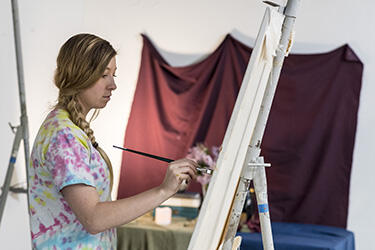
Of all the arts, painting possesses one of the longest and richest traditions. The painting area in Wright State’s School of Fine and Performing Arts attempts to draw on the best and most timeless aspects of that tradition. You will work primarily from life in most classes, developing skills and fluency in the language of painting, but you will also be encouraged to experiment with abstract, contemporary, and personal styles in out-of-class and independent work. When you complete your degree, you will have a solid foundation and a unique appreciation for how painting fits into today's art world.
Facilities
Photography
Our photography program offers courses in traditional, digital and alternative photographic processes with an emphasis on creative expression in the fine arts. Your coursework is designed to teach you both photographic practice and theory. You will explore both technical and aesthetic concerns while developing your own artistic vision. Assignments encourage and promote creative thinking while stressing the importance of craft. Course lectures and critiques examine the photographic works within cultural contexts emphasizing historical and contemporary perspective of the medium.
Facilities
Printmaking
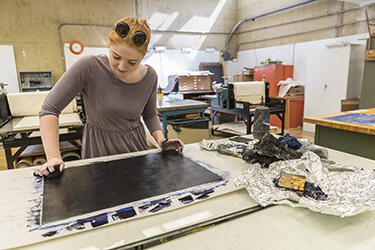
The goal of the printmaking concentration is to provide you with a broad range of technical and creative tools that will allow you to discover new ways of adding to the printmaking tradition. Printmaking is a medium that comfortably embraces the most traditional as well as contemporary technologies. This openness to innovation invites challenge, exploration, and inventive combinations that continue to expand the parameters of what is possible in image making. Processes include intaglio, lithography, relief, silkscreen, and photomechanical techniques. Along with gaining technical proficiency, you will learn about artistic self-analysis through group and individual critiques.
Facilities
Sculpture
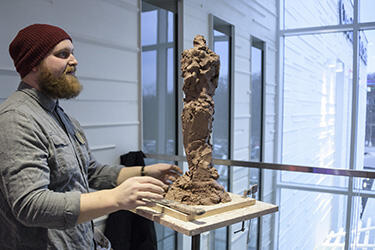
Sculpture at Wright State encompasses a broad range of traditional and new approaches. You will be exposed to the openness of the field and encouraged to explore the varied and creative possibilities of the discipline. A series of courses bring together the importance of tradition as the foundation for understanding sculptural form and space. You can grasp exciting opportunities that will arise with the addition of new methods and technologies. Receive a solid preparation in time-honored processes such as modeling, carving, casting, and fabrication, and are introduced to contemporary sculpture practice by way of installation, performance, and digital media. These courses seek to develop an understanding of the relationship between form and content and foster within you the drive and ability to make relevant work.
Facilities
Admission
Review the admission requirements and complete the admission application. Identify whether you will be majoring in art.
If you are a current student and wish to change majors, submit a Major/Minor Change Request by logging in to WINGS, then select Student Academics under Your Launchpad. If you are an undecided/exploratory student, talk to your advisor about majoring in art.
Scholarships
Scholarships for Incoming Students

Scholarships are based on both financial need and talent. They will be awarded based on a review of portfolios as well as an assessment of your high school transcripts, references, and financial need.
Scholarships are given for the first two years at Wright State, up to $3,000 per year. After the initial two-year period, you will be eligible for the art program's talent scholarships for continuing students.
Eligibility
- You must be an incoming student (not a transfer student).
- You must remain an art major; the scholarship will be rescinded if you choose to major in another area.
How to Apply
Download and complete the Incoming scholarship application. You will need to provide two references with contact information who can speak to your artistic accomplishments and a high school transcript. Submit a portfolio, either digitally or in person to the art department, consisting of a maximum of 20 works. No more than 10 pieces should be in any one medium.
Submitting the application and portfolio electronically:
- Download the application and submission guidelines below. Follow the directions for sizing and labeling your images. Complete the application form and inventory sheet and email all materials, including high school transcript, to art_arthistory@wright.edu. You can send your materials in multiple emails if needed.
- All materials must be emailed before 3 p.m. on March 12, 2025.
Submitting the application and portfolio to the art department:
- Deliver a portfolio (consisting of a maximum of 20 works, no more than 10 in any one medium); a list of two references with contact information who can speak to your artistic accomplishments; and a high school transcript to the School of Fine and Performing Arts office in the Creative Arts Center in 088 CAC.
- All works in the portfolio should be clearly labeled on the back with your name, address, and phone number. While original works are preferred, you have the option of turning in unframed originals or digital files (in jpg or pdf format) on a thumb drive.
- Portfolio and application materials can be dropped off Monday, February 10 to Wednesday, March 12, 2025, between 9 a.m.–4 p.m. at the School of Fine and Performing Arts office in the Creative Arts Center in 088 CAC. The portfolio must be clearly labeled with your name, address, and phone number.
ArtsGala Scholarship Application for Incoming Students (PDF)
Electronic Submission Guidelines (PDF)
Any questions? Call Tracy Longley-Cook, Art Professor, at 937-775-3547.
Scholarships for Continuing Studio Art Majors and Art History Majors

The School of Fine and Performing Arts awards a limited number of Special Talent Scholarships to both full-time and part-time continuing studio majors and art history majors who will be enrolled during the Fall and Spring semesters of 2025–2026. If you are a B.F.A. or B.A. candidate who has a minimum of 12 hours within the art and art history programs, you are eligible to apply. Your total number of hours includes those courses for which you are enrolled for current Spring Semester.
You are strongly encouraged to fill out a FASFA each year, even if you believe you don't qualify for financial aid. It may open avenues to other scholarship opportunities but does not disqualify you if you don't apply.
Studio majors and art history majors may receive a total of five special talent scholarship awards during their matriculation toward a degree. To be eligible to re-apply for a scholarship, B.F.A. and B.A. candidates must complete a minimum number of credits in the department during the ensuing year(s). Following the spring semester of your special talent award, scholarship recipients must earn a minimum of 12 credit hours in studio art in Art and Art History, including credit hours for courses in progress (Spring Semester) at the time of your next portfolio review application.
For studio art majors, portfolios may include a maximum of 20 works, with no more than 10 in any of the following media: drawing, painting, sculpture, printmaking, and photography. Slides or digital images may represent sculptures. Only work done since the last scholarship portfolio review is eligible. Only work done while at Wright State is eligible.
Art history majors may submit two art history papers with comments and grades in person to the School of Fine and Performing Arts office, 088 Creative Arts Center, or email to art_arthistory@wright.edu along with a completed art history scholarship application.
Register and pick up a scholarship application and directions for submission in the School of Fine and Performing Arts office (088 Creative Arts Center, during the hours of 9 a.m.–noon and 1–3 p.m.) from February 10–March 12, 2025. Portfolio drop-off and jurying will take place on Friday, March 14, 2025. You can pick up your portfolio by 3 p.m. that afternoon.